The Shelter You Hope Never to Unwrap: A Bothy Bag Reality Check
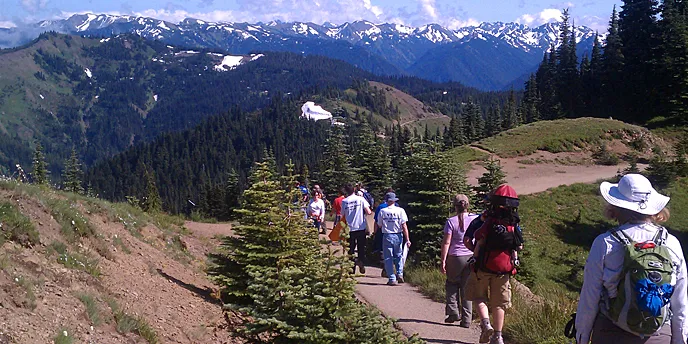
Photo: Olympic National Park, Public domain, via Wikimedia Commons
Picture the scene. You're two hours up a Lakeland fell, the cloud has dropped like a curtain, and the wind is doing that thing where it pushes the words back into your mouth. Someone in the group is shivering. Not dramatically, not yet — just quietly, hands fumbling with a zip. You have a flask, a foil blanket and a phone with 4% battery. What you don't have is anywhere to get out of it.
That gap is exactly what a bothy bag fills. And it costs about thirty quid.
What it actually is (and isn't)
A bothy bag is a lightweight, windproof and water-resistant fabric shelter — essentially a big, brightly coloured sack you sit inside. Two people, four people, eight people; you climb in, pull it over your heads, sit on the edges to seal it down, and let your collective body heat do the rest. Most have a small mesh or clear window, a vent or two, and a drawcord at the base.
It is not a tent. It is not a bivvy bag. It won't keep you dry through a night out and it won't survive being pitched on an exposed ridge in a full gale unless you're using it properly. What it does is stop the wind, trap warmth and turn a miserable, deteriorating situation into twenty manageable minutes while you eat something, sort out your layers, check the map and decide what to do next.
Think of it as a portable waiting room. Sometimes the safest move on a British hill is to stop, get warm and think. A bothy bag makes stopping possible.
Why UK weather makes it more than a niche extra
In the Alps you often get a forecast you can trust and a cable car down. In the UK you get four seasons in an afternoon, summit temperatures that sit five degrees below the valley, and windchill that quietly turns a pleasant October walk into a hypothermia risk. Our hills aren't high, but they're famously wet, windy and close to the sea — a combination that saps heat fast.
That's before you factor in how many of us adventure in the margins. A dusk run across the Yorkshire Dales. A coasteering session in Pembrokeshire that gets cut short by a squall. A winter round of the Cairngorms where the daylight budget is genuinely tight. Mountain rescue teams carry group shelters for a reason, and the reason isn't that incidents are exotic — it's that they're ordinary.
You are far more likely to need a warm, windproof bubble for twenty minutes than you are to need a whistle, and you probably carry one of those.
Choosing one without overthinking it
A few things genuinely matter.
- Size for the group, plus one. A two-person bag used by three adults is a wrestling match. Buy for the biggest group you realistically walk with, and remember kids and dogs take up space too.
- Weight and packed size. Most sit between 200g and 500g. Anything in that band is fine; you're not shaving grams off a race kit here.
- Colour. Bright. Rescue-me orange, lime, red. If you're sitting inside it, you want the outside visible from a helicopter.
- Vents and a window. Condensation is real. So is the desire to see where you are.
- Taped or sealed seams. Cheap bags leak at the seams within a season. Check before you buy.
Budget £25–£50 for a decent one. That's a waterproof jacket's worth of money for something you'll carry for a decade.
Packing it so it's actually usable
A bothy bag buried at the bottom of a crammed 30-litre pack is a bothy bag you won't deploy. Two rules:
- Put it where you can reach it without taking your pack off in the wind. Top lid, or a side pocket if it fits.
- Know which end is which. A bag with a grab handle or a brightly marked top is easier to shake out one-handed with gloves on.
Pair it with a small sit mat, an emergency blanket and a headtorch in the same pocket. That little bundle — warmth, light, insulation from the ground — covers most of what a bad twenty minutes throws at you.
The five-minute drill worth doing
Do this once, on a dry, calm day, in a park or at the trailhead. It takes five minutes and it turns a theoretical item into muscle memory.
- Shake the bag out fully. Wind matters more than anything — get it open and overhead fast.
- Two people climb in, sit on the edges, and pull it down to chest height. Sealing the base is what traps the heat.
- Get the window and vent sorted. Notice how quickly it warms up.
- Eat something. Drink something. Talk through the next decision as if it were real.
- Pack it away the same way it came out, in the same pocket.
Then do it again with gloves on and a hood up. That's the version you'll actually face.
The honest limits
A bothy bag buys time; it doesn't replace judgement. If someone is properly cold — slurring, clumsy, unusually quiet — a bag is a step, not a solution. Get them out of the wind, add insulation, feed them sugar, and be ready to call for help early rather than late. Signal is patchy on UK hills; a bothy bag gives you a sheltered spot to keep trying the phone, and keeps the rest of the group functioning while you do.
And please, don't treat it as a bothy. Sleeping in one on a Scottish hillside in February is a story, not a strategy.
Thirty quid. Two hundred grams. One pocket. For UK walkers, runners and coasteerers, it's the cheapest piece of proper safety kit you can carry — and the one you'll be most grateful you never had to use.